

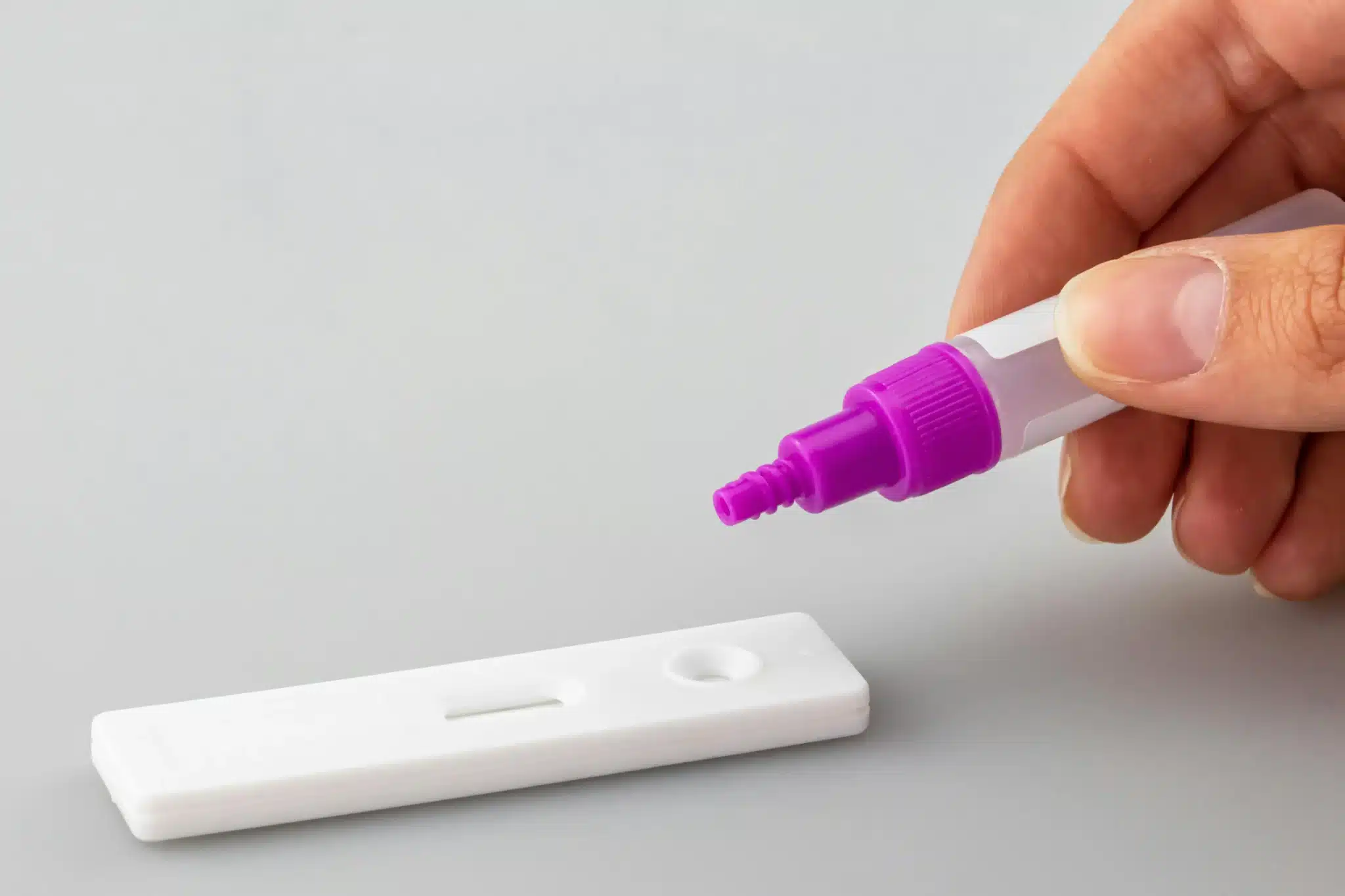
Key takeaway: using lemon does not produce a negative result, but invalidates the saliva test by blocking the “C” control line. This anomaly is interpreted as an attempt to cheat and may lead to a blood test. The only reliable way to avoid a positive test remains complete absence of THC, by choosing THC-free CBD products.
Many drivers wonder whether it is possible to cheat a saliva test with lemon to conceal recent use. However, scientific data and police protocols show that acidity does not fool modern screening devices. This article explains how the tests actually work, the consequences of attempting to cheat, and the legal solutions for staying compliant with the law.
- The lemon myth: why this misconception persists
- How a modern saliva test works
- Consequences of an attempt to cheat
- Legal and administrative risks
- What the only reliable strategy is
The lemon myth: why this misconception persists
Acidity and dilution: a misleading line of reasoning
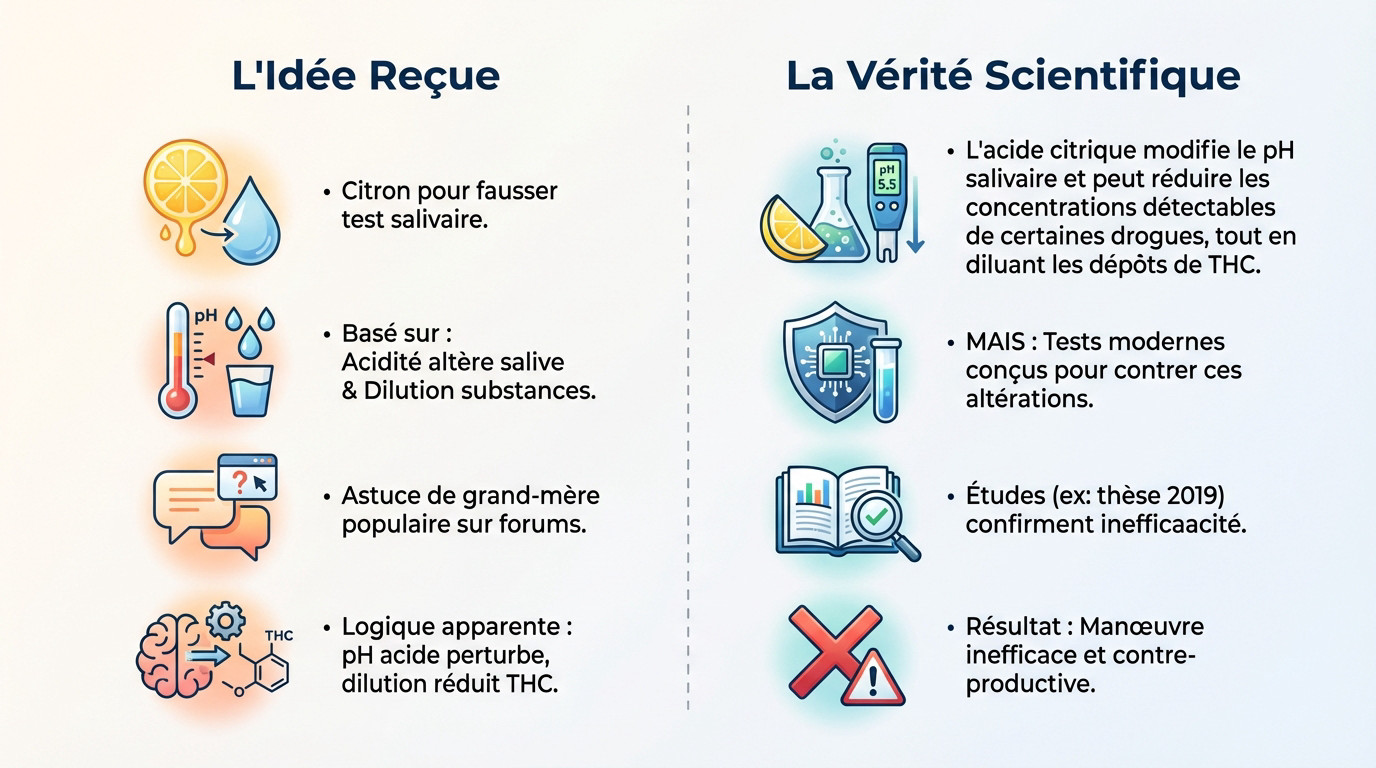
The idea of cheating a saliva test with lemon is based on two beliefs: that acidity would change saliva, and that increased salivation would dilute THC. This theory has circulated for years on forums and social networks, especially among users of high-THC strains such as Cali Weed.
In practice, while citric acid temporarily changes salivary pH, it does not eliminate THC metabolites present in the oral mucosa.
What science says
A French university thesis in dental surgery (2019) shows that artificial variations in salivary pH are detectable by certified screening devices. The alteration makes the test invalid rather than negative.
Source: Dental surgery thesis – University of Bordeaux
How a modern saliva test works
Targeted immunological detection
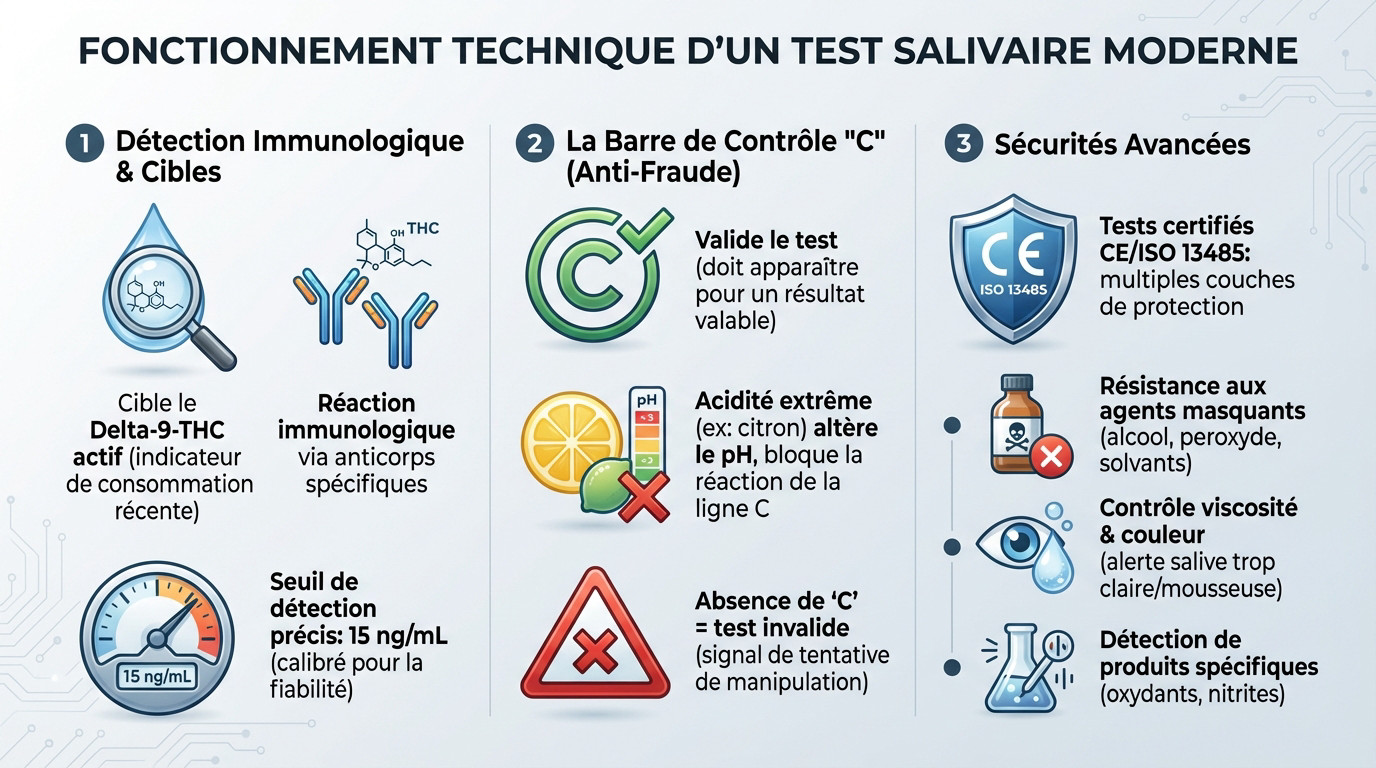
Roadside saliva tests do not look for “cannabis” but specifically delta-9-THC. They use an immunological reaction: antibodies bind to THC if it is present, which prevents the test line from appearing.
The detection threshold used by professional tests is generally set at 15 ng/mL. To check yourself before a roadside check, you can use a reliable THC test available online.
Manufacturer source: Technical leaflet – THC saliva test (Toda Pharma)
The “C” control line: a key element
The “C” line does not detect THC. It confirms that the test is working properly. If the pH or viscosity of the saliva is abnormal, the control line does not appear.
In this case, the test is technically invalid and cannot be interpreted as negative.
Pharmacy tests vs professional tests
A frequently overlooked point is the difference between saliva tests sold in pharmacies and those used by law enforcement.
Pharmacy tests
Most consumer tests detect THC but also CBD. They do not distinguish between cannabinoids and may show a positive result after using CBD products, even in the absence of THC.
Professional tests
The tests used by the police and certain institutions are calibrated only for THC and do not react to pure CBD.
To better understand the difference between CBD and THC during screening, this video from Le Moniteur des pharmacies provides a professional perspective on the subject:
Consequences of an attempt to cheat
Believing that acidity will mask toxins is a major technical mistake. Attempting to cheat a saliva test with lemon does not produce a negative result, but an immediate reading error on the device.
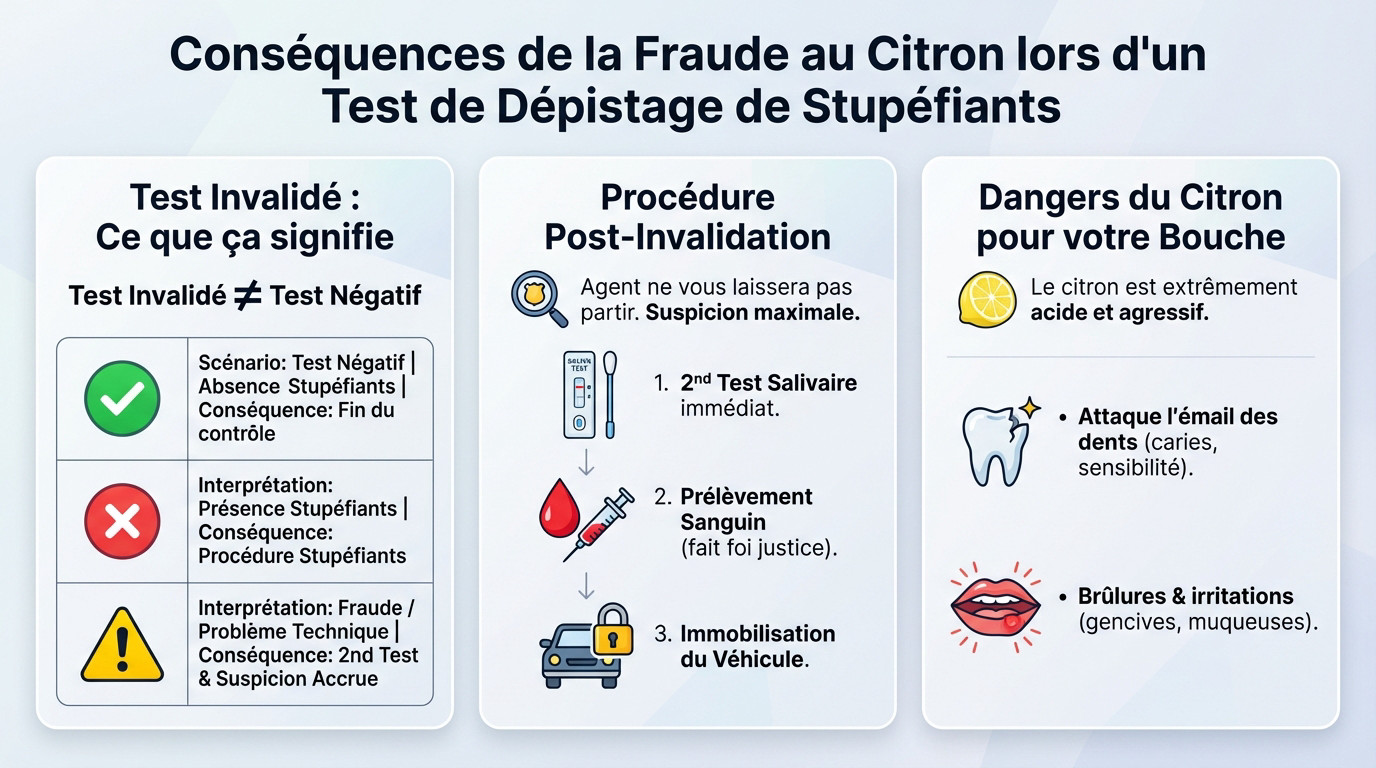
Invalid test ≠ negative test
Using lemon does not erase THC. It causes an invalid test, interpreted as a technical anomaly or an attempt at manipulation.
Result / Interpretation / Consequence
Negative / No substance detected / End of check Positive / Presence of THC / Criminal proceedings Invalid / Suspected fraud / Second test or blood test
Risks to oral and dental health
Repeated application of highly acidic substances such as pure lemon juice can cause dental enamel erosion and lesions of the oral mucosa.
Medical source: French Union for Oral and Dental Health
Legal and administrative risks
Under Article L235-2 of the French Highway Code, evading or attempting to evade screening constitutes a criminal offence.
Possible penalties:
- Up to 2 years’ imprisonment
- Up to a €4,500 fine (depending on the offence)
- Deduction of 6 points
- Suspension or cancellation of the driving licence
Official sources:
Driving after drug use – Service-Public.fr
Article L235-2 of the French Highway Code – Légifrance
What the only reliable strategy is
Roadside tests target THC exclusively. They do not detect cannabidiol (CBD) when it is completely free of THC.
The only reliable approach is therefore not to consume THC and to choose THC-free CBD products whose absence of this molecule is certified by independent laboratory analyses.
This strategy makes it possible to remain compliant with the law without resorting to ineffective or risky methods.